
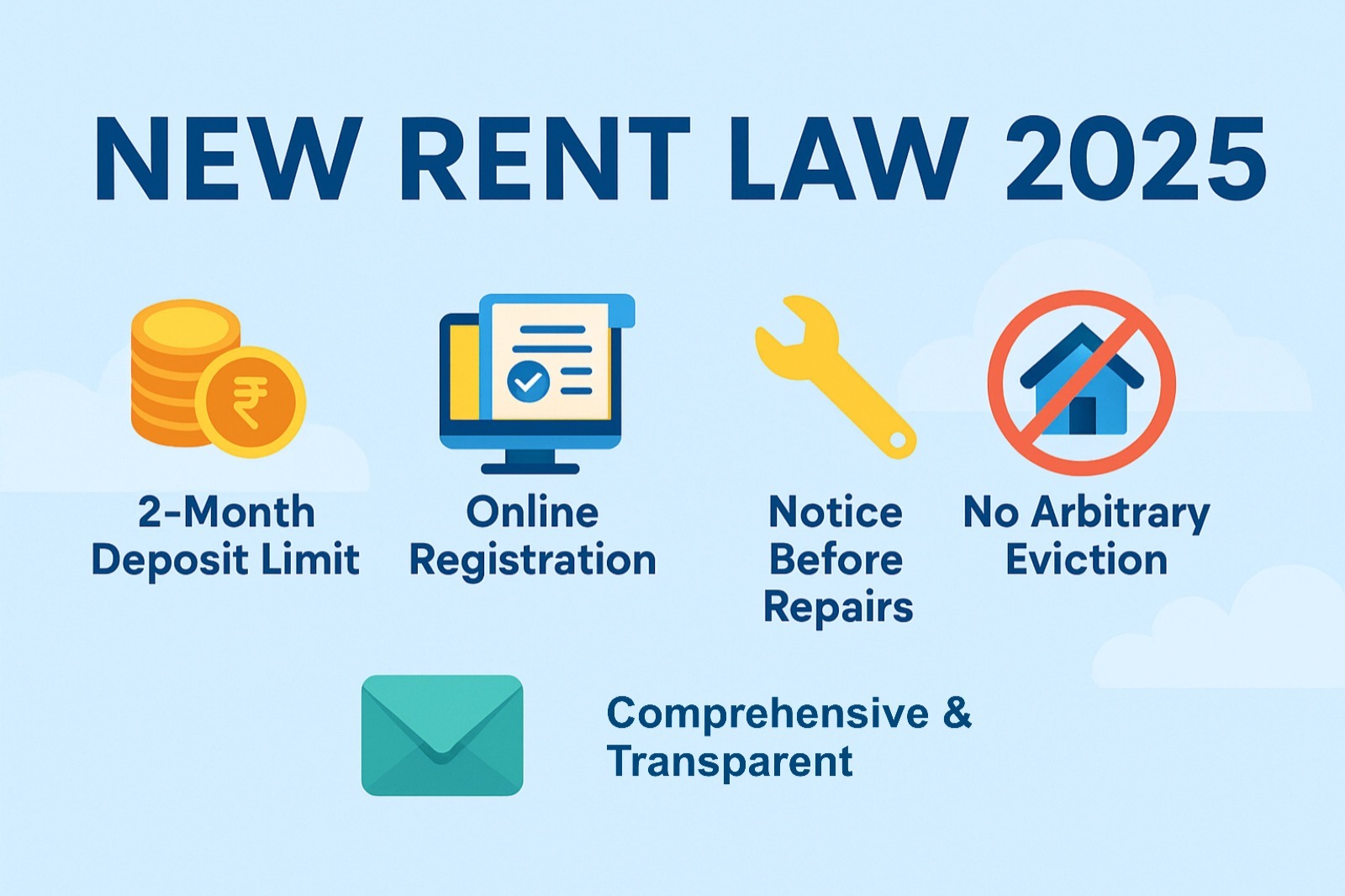
Rent Law 2025: What You Must Know Before Renting or Letting
The Rent Law 2025 brings major reforms to renting homes in India. Whether you are a tenant or a landlord, this new law aims to make renting fairer, safer, and more transparent.
What Is the 2025 Rental Agreement Law
The 2025 rental agreement law changes how rental deals are made. From now on:
- All agreements must be in written form. Verbal deals are no longer legal.
- The agreement must be digitally stamped and registered online within 60 days after signing.
- If not registered, a penalty (starting ₹5,000) may apply and the agreement might not be legally valid.
This means the rental system will now be cleaner, documented, and legal — good news for both landlords and tenants.
Security Deposit Rules Under Rental Law 2025
One of the biggest changes under Rent Law 2025 is about the security deposit:
- For residential premises, deposit is capped at 2 months’ rent.
- For commercial premises (shops, offices), deposit is limited to 6 months’ rent.
This cap reduces the burden on tenants — earlier many had to pay 6-10 months’ rent as deposit upfront.
Rent Increase & Notice Rules Under Rent Law 2025
The 2025 rent rules for India also regulate how rent can be increased:
- Rent can be revised only once every 12 months.
- Landlord must give at least 90 days’ written notice before a rent hike.
This makes things predictable for tenants. Sudden or arbitrary rent hikes will no longer be allowed.
Privacy & Entry Rights: What Rent Law 2025 Says
Under the Rental Law 2025 Act, landlords must respect tenants’ privacy and follow certain rules before entering the rented home:
- A written notice, 24 hours in advance, is required before inspection or entry.
- Entry must happen during reasonable hours. No surprise visits allowed.
This change protects tenants’ personal space and ensures fairness from landlords.
Maintenance & Repairs: Clarity for Both Parties
The new law clarifies who does what:
- Major structural repairs — leaks, plumbing, safety issues — remain landlord’s responsibility.
- Tenants must handle everyday usage and minor maintenance (e.g. bulbs, cleaning).
With this clear split, disputes over “who fixes what” are easier to resolve fairly.
Eviction & Dispute Rules Under Rent Law 2025
The law also protects tenants from sudden eviction and unfair practices:
- Landlord cannot evict tenant without a proper legal notice and process.
- Disputes over rent, damage, or eviction can go to the Rent Authority / Tribunal, which resolves cases quickly — often within 30 to 60 days.
This ensures that both landlords and tenants get justice fast — without long delays.
Why Rent Law 2025 Is a Big Win for Tenants & Landlords
For Tenants:
- Lower upfront cost (only 2 months deposit)
- Legal security with registered agreement
- Transparent rules for rent hikes and eviction
- Protection for privacy and rights
For Landlords:
- Formal, legally valid agreements reduce disputes
- Digital payment and documentation make rent collection easier
- Clear terms help avoid misunderstandings
Overall, Rental Law 2025 aims to build trust, fairness, and clarity in Indian rentals.
What You Should Do Now (Tenant or Landlord)
- Always draft a written rental agreement — no verbal deals.
- Register your agreement online within 60 days after signing.
- Keep deposit within the legal limit (2 months for homes).
- Agree on rent increase and notice terms in writing.
- Use online rent payment if possible — it gives legal proof.
- Respect privacy and maintenance responsibilities.
- If there’s a dispute — take it up with the local Rent Authority or Tribunal.
Need a 2025-compliant rental agreement? LegalDesk.com makes it fast, legal, and fully digital.
Frequently asked questions (FAQs)
What is the New Rent Law 2025 in India?
The New Rent Law 2025 is a national rental reform built on the Model Tenancy Act 2021. It makes written, registered agreements mandatory, caps security deposits, regulates rent hikes, and introduces Rent Tribunals for faster dispute resolution.
If you’ve ever rented a home in India — dealing with vague verbal agreements, surprise rent hikes, or a landlord showing up unannounced — the New Rent Law 2025 was made for you. Rooted in the Model Tenancy Act 2021 framework, it brings India’s rental system into the digital age. Verbal deals are out. Registered, stamped, legally binding agreements are in. Security deposits are capped. Rent increases follow fixed rules. And disputes get resolved in weeks, not years. Whether you’re renting a flat in Bengaluru or letting out a shop in Delhi, this law changes the ground rules for both sides.
Is a verbal or handwritten rental agreement valid in 2025 rent law?
No. Verbal and handwritten rental agreements are no longer legally valid under the New Rent Law 2025. All agreements must be in writing, digitally stamped, and registered within 60 days of signing.
The short, definitive answer is no — they are not valid anymore. For decades, renting in India ran largely on trust, a handshake, or a hastily typed note on plain paper. That era is over. Under the 2025 rules, only a written, digitally stamped, and officially registered rental agreement carries legal weight. If a dispute ever reaches a Rent Tribunal — over unpaid rent, deposit refusal, or eviction — an unregistered or verbal agreement will leave both parties with little to stand on. Writing it down is no longer optional; it is the foundation of a legal rental relationship.
When must a rental agreement be registered and what is the penalty for missing the deadline?
A rental agreement must be registered within 60 days of signing. If not registered, the agreement may be legally invalid and the landlord can face a penalty starting from ₹5,000, with some states adding daily fines.
The clock starts the moment both parties sign the agreement — you have 60 days to get it registered. This can be done entirely online through your state government’s portal, or offline at a Sub-Registrar’s office. Skip the registration window and the consequences are real: the agreement may not hold up in a legal dispute, and the landlord can be penalised starting at ₹5,000, with some states imposing additional daily fines until registration is completed. One important nuance — short-term agreements under 11 months are treated differently in most states, where a notarised agreement is widely accepted without full registration.
What is the maximum security deposit a landlord can legally charge in 2025?
Under the New Rent Law 2025, the security deposit is capped at 2 months’ rent for residential properties and 6 months’ rent for commercial spaces. Any demand above this limit is now illegal.
This is arguably the biggest win for tenants in the new law. In cities like Bengaluru and Mumbai, it was completely normal for landlords to demand 6, 8, or even 10 months’ rent as a security deposit upfront — a financial wall that kept many families from accessing decent housing. The 2025 rules bring a hard cap: 2 months’ rent maximum for residential properties, and 6 months’ rent for commercial spaces such as shops and offices. If a landlord demands more than this, they are in violation of the law. Tenants have the right to refuse and can file a complaint with the local Rent Authority.
How often can a landlord increase rent and how much notice must they give?
Under the New Rent Law 2025, rent can only be revised once every 12 months. The landlord must give a minimum of 90 days’ written notice before any rent increase takes effect.
Surprise rent hike messages — the kind that arrive with barely a month’s notice — are now off the table. The 2025 rules are clear: rent can go up no more than once per year, and the landlord must give at least 90 days’ advance written notice before the change kicks in. The revised amount must also follow the terms agreed upon in the original rental agreement, which typically outlines a pre-approved annual percentage. If a landlord tries to raise the rent mid-lease without proper notice, that increase can be challenged at the Rent Authority. Tenants now have the time and legal grounds to plan ahead, negotiate, or object.
Can a landlord enter a rented property without notice?
No. Under the New Rent Law 2025, a landlord must give at least 24 hours’ written notice before entering a rented property. Entry must happen during reasonable hours. Cutting off utilities as a pressure tactic is also now a punishable offence.
A rented home is still a tenant’s private space — and the new law makes that legally enforceable. If a landlord wants to visit for inspection, repairs, or any other purpose, they must give at least 24 hours’ advance written notice, and must arrive during reasonable hours of the day. Unannounced visits are prohibited. Taking it further, any landlord who disconnects water, electricity, or internet to pressure a tenant into leaving is committing a punishable act under the 2025 framework. These protections apply whether you’re renting a flat in Bengaluru or a studio in Mumbai.
Under what circumstances can a landlord legally evict a tenant?
A landlord can legally evict a tenant in 2025 only through a formal Rent Tribunal order. Valid grounds include two or more months of unpaid rent, subletting without consent, structural damage to the property, or the landlord’s genuine personal need for the premises.
Eviction is no longer something a landlord can do unilaterally or without due process. To remove a tenant, the landlord must apply to the Rent Tribunal and obtain a formal eviction order. The law defines clear, valid grounds for eviction: non-payment of rent for two consecutive months or more; subletting the property to someone else without written consent; causing deliberate structural damage; or needing the property back for personal use, which requires at least one month’s advance notice. Tenants also cannot claim ownership of a property regardless of how long they have lived there — a concern that has historically discouraged many landlords from renting out at all.
How are rental disputes resolved under the New Rent Law 2025?
Under the New Rent Law 2025, rental disputes are resolved by dedicated Rent Tribunals, which are designed to settle cases within 60 days — replacing years of civil court delays.
One of the most transformative aspects of the 2025 rules is the introduction of dedicated Rent Tribunals — specialised forums built exclusively for rental disputes. Before this, a disagreement over a security deposit refund or an unlawful eviction could drag on in civil court for two to three years, exhausting both parties. Rent Tribunals are designed to move fast, with a target resolution window of 60 days. Whether the dispute involves unpaid rent, deposit deductions, maintenance failures, privacy violations, or wrongful eviction — both landlords and tenants now have a faster, less intimidating path to fair resolution. Complaints can be filed directly with the local Rent Authority to initiate the process.
Is police verification of tenants mandatory under the new rules?
Yes. Police verification of tenants is mandatory under the New Rent Law 2025 before they move into a rented property. This protects both parties and creates an official record. Many cities now allow this process to be completed entirely online.
Police verification has been made a compulsory step before a tenant moves in — not as a barrier, but as a protective measure for everyone involved. For landlords, it creates an official record of who is occupying your property, reducing the risk of misuse or legal complications down the line. For tenants, having a verified paper trail actually protects them from false accusations or disputes about occupancy. In many major cities today, the process has moved online — you can submit documents, Aadhaar details, and photographs digitally through state portals without visiting a police station. In some cities, a physical form is still required. Either way, it is the landlord’s responsibility to ensure verification is completed before handing over the keys.
Does the New Rent Law 2025 apply uniformly across all Indian states?
No, not yet uniformly. The New Rent Law 2025 is a central framework based on the Model Tenancy Act 2021. Each state must adopt or adapt it through its own legislation. States like Maharashtra, Karnataka, Tamil Nadu, Delhi, Gujarat, and Uttar Pradesh are already aligning. Others are in progress.
This is a critical nuance that many renters and landlords overlook. Because land and tenancy fall under the State List in India’s Constitution, the central government cannot unilaterally enforce rental rules across the entire country. The 2025 framework is a template — a modern, carefully designed standard that states are expected to adopt and implement through their own laws. Early movers include Maharashtra, Karnataka, Tamil Nadu, Delhi, Gujarat, Uttar Pradesh, Andhra Pradesh, and Assam. Others are in various stages of review and alignment. Until your specific state formally adopts the rules, the exact provisions in force will vary. Always check your state’s official Rent Authority portal before signing or renewing any agreement.
Need a 2025-compliant rental agreement? LegalDesk.com makes it fast, legal, and fully digital.
🔗 References & Further Reading
Ministry of Housing and Urban Affairs