
Make Your Own Affidavit Online
Now create your affidavit online within minutes using our pre-drafted, ready to use affidavit templates availabe on this portal! You can downlad the soft copy and print it on Stamp papers. Or just fill in your details in the form and opt for delivery service in which we will print your affidavit on Stamp Paper of requisite value and deliver the same to your doorstep!
 Name & Address Affidavits
 Personal Affidavits


Making Affidavits In India
Frequently Asked Questions (FAQs)
This section answers the most common questions about affidavits in India — what they are, how they work, where to get them executed, and what legal framework governs them.
1. What is an affidavit under Indian law?
An affidavit is a written statement where a person declares that the information provided is true. It is signed under oath before an authorized official such as a Notary Public or Magistrate, making it a legally valid document that can be used before courts and government authorities.
2. Is an affidavit legally valid in India?
Yes. An affidavit is a legally recognized document in India. It derives validity from the Indian Evidence Act, 1872, the Notaries Act, 1952, and the Oaths Act, 1969. When executed before an authorized official and drafted on appropriately stamped paper, an affidavit is admissible as evidence and accepted by courts, government departments, banks, embassies, and other official bodies.
3. Who can make an affidavit?
Any person who is 18 years of age or older, of sound mind, and understands the consequences of making a sworn statement can execute an affidavit. In cases involving minors or persons of unsound mind, a parent, legal guardian, or authorized representative may execute the affidavit on their behalf, stating the relationship clearly within the document.
4. Before whom can an affidavit be executed in India?
An affidavit can be executed before: (1) A Notary Public appointed under the Notaries Act, 1952; (2) A Judicial Magistrate or Executive Magistrate; (3) An Oath Commissioner appointed under the Oaths Act, 1969; or (4) Any other officer specifically empowered by law, such as certain gazetted officers where applicable. The authority required may vary based on the purpose for which the affidavit is being submitted.
5. What is the difference between a notarized affidavit and a sworn affidavit?
A sworn affidavit is signed after the person takes an oath or affirmation before an authorized official. A notarized affidavit is one where a Notary Public verifies the person’s identity, witnesses the signature, and affixes their seal. In practice, most affidavits in India are both sworn and notarized at the same time (under the Notaries Act, 1952.)
6. What is stamp duty on an affidavit, and how much is it?
Stamp duty is a state-subject tax levied on legal instruments, including affidavits, under the Indian Stamp Act, 1899 and respective State Stamp Acts. The amount varies by state. For example, in many states, a general affidavit requires a stamp paper of Rs. 10 to Rs. 100. However, affidavits for property transactions, court submissions, or specific government purposes may require higher-denomination stamp paper. Always check your state’s stamp schedule before drafting. Using insufficient stamp paper can render the affidavit inadmissible.
Note: Stamp duty rates are state-specific and may change from time to time. Always verify the current rate before purchasing stamp paper
7. Can I draft an affidavit myself, or do I need a lawyer?
Yes, you can draft an affidavit yourself. However, it must be clear, accurate, and properly formatted as per the requirements of the authority where it will be submitted. Mistakes such as incorrect details, vague statements, or missing attestation (Sign) can lead to rejection. For simple affidavits (like address proof or date of birth), self-drafting is usually sufficient. For complex matters such as property disputes, court cases, or immigration, consulting an advocate is advisable.
8. What is the format of an affidavit?
A standard affidavit in India includes the following components: (1) Title indicating the type of affidavit; (2) Details of the deponent — full name, parentage, age, occupation, and address;
(3) A clear statement of the facts being declared;
(4) A verification clause confirming that the contents are true to the best of the deponent’s knowledge; (5) Date and place of execution;
(6) Signature of the deponent; and
(7) Attestation by the Notary/Magistrate with their seal, signature, and registration number.
9. Is an affidavit the same as a declaration or an undertaking?
No. While related, these are distinct documents. An affidavit is a sworn statement of facts made before a competent authority. A declaration is a formal written statement but may not require an oath. An undertaking is a promise or commitment to do or refrain from doing something. Depending on the requirement of the receiving authority, you may need any one or a combination of these documents.
10. How long is an affidavit valid in India?
Indian law does not prescribe a universal expiry date for affidavits. However, different government departments and institutions set their own validity norms. For example, many government schemes and embassies accept affidavits executed within the last 3 to 6 months. Affidavits submitted to courts are generally valid for the duration of the proceedings. Always check the specific requirement of the authority where you intend to submit the affidavit.
11. Can an affidavit be used as a substitute for a government-issued certificate?
An affidavit can be used as a supporting document or interim substitute in specific situations — for example, an affidavit for date of birth may be accepted by some schools or employers when a birth certificate is unavailable. However, for purposes like obtaining a passport, PAN card, or driving licence, primary documents are mandatory and affidavits serve only as supplementary evidence. The Supreme Court of India and various High Courts have held that affidavits are legally sufficient in several self-declaration scenarios.
12. What is the difference between an affidavit and a statutory declaration?
An affidavit is a sworn statement made under oath, typically used in legal or quasi-legal proceedings. A statutory declaration is a formal statement declared under specific legislation (such as the Statutory Declarations Act applicable in some Commonwealth contexts). In India, the term ‘statutory declaration’ is less commonly used, and affidavits largely serve the same purpose in domestic proceedings.
13. Does an affidavit need to be registered?
Not necessarily. Most affidavits in India do not require registration under the Registration Act, 1908. Notarisation by a Notary Public is usually sufficient. However, affidavits that are part of transactions involving immovable property or that need to be presented in a court as primary evidence of title may require registration. Always check whether the authority or the court in question requires registered documents.
14. What happens if the facts stated in an affidavit are false?
Providing false information in an affidavit is a criminal offense. Under Section 191 read with Section 193 of the Indian Penal Code, 1860 (now Bharatiya Nyaya Sanhita, 2023), making a false statement on oath or in a verification is punishable with imprisonment up to seven years and a fine. This underlines the importance of ensuring every statement in an affidavit is accurate, complete, and verifiable.
15. Can an affidavit be amended or corrected after execution?
No. Once an affidavit is executed and attested, it cannot be altered. If you discover an error after execution, you must draft a fresh affidavit clearly stating the correction and the reason for it. The corrected affidavit should reference the original one by date and nature.
16. What documents are needed to get an affidavit executed?
You will typically need: (1) Identity proof — Aadhaar card, PAN card, Voter ID, or Passport; (2) Address proof — utility bill, ration card, or bank passbook; (3) Relevant supporting documents specific to the type of affidavit (e.g., old name documents for a name change affidavit); (4) Passport-size photographs (in some cases); and (5) Stamp paper of appropriate value as required by your state.
17. How many witnesses are required for an affidavit?
Generally, witnesses are not required for a basic affidavit. The deponent signs in the presence of the attesting authority (Notary/Magistrate). However, some courts and authorities may require one or two witnesses for specific types of affidavits, particularly those related to property transactions or matrimonial proceedings. Check the specific requirements of the concerned authority.
18. Can an NRI or person abroad execute an affidavit for use in India?
Yes. An Indian citizen residing abroad can execute an affidavit before the Indian Consulate or Embassy, or before a local Notary Public in the country of residence, followed by apostille or consular attestation as required. The affidavit must then be submitted along with the apostille certificate to the concerned Indian authority. The Hague Convention on Apostille applies for the countries that are signatories.
19. Are there different types of affidavits in India?
Yes, affidavits serve a wide range of purposes in India, including: Name change, Date of birth proof, Address proof, One and same person, Name correction, Marriage-related declarations, Income declarations, Lost document declarations, Succession and inheritance claims, Property-related declarations, Educational qualification declarations, and Affidavits for court proceedings. Each type has specific content requirements depending on the purpose and the receiving authority.
20. What is a self-declaration affidavit, and is it valid?
A self-declaration affidavit is a document in which the deponent declares certain facts about themselves — such as their name, date of birth, or marital status — without third-party attestation beyond the notarization. The Supreme Court of India, in various judgments, has upheld the validity of self-declarations particularly for matters where original documents have been lost or never issued. However, the acceptability of such affidavits depends on the specific policy of the authority to whom it is submitted.
21. What is the process to get an affidavit notarized?
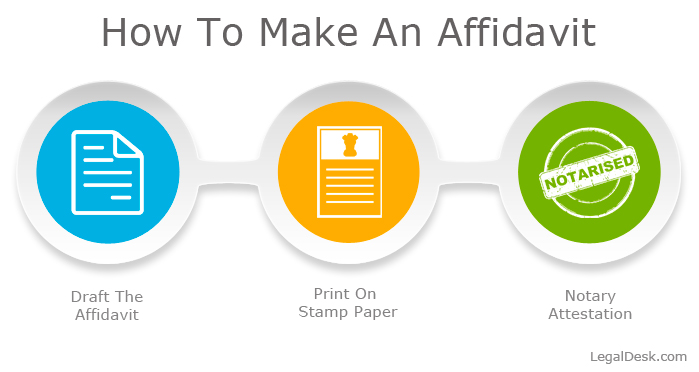
The process is: (1) Draft the affidavit on appropriate stamp paper; (2) Visit a Notary Public with original identity documents; (3) The Notary verifies your identity; (4) You sign the affidavit in the Notary’s presence after taking an oath; (5) The Notary affixes their seal, sign, and registration number; (6) The executed affidavit is now legally valid. This process is usually completed within 30 minutes.
22. Can affidavits be executed online in India?
While the content of an affidavit can be drafted online, the physical execution — signing before a Notary or Magistrate — still requires in-person presence under current Indian law. However, e-stamping services are available in many states (such as Karnataka, Delhi, Maharashtra) to purchase stamp paper online. Some platforms also provide doorstep affidavit services where a Notary visits you. Fully remote electronic affidavits are not yet universally recognized in India.
23. What is e-stamping, and is it valid for affidavits?
E-stamping is an electronic alternative to traditional stamp paper, introduced to prevent fraud associated with counterfeit stamp papers. Authorized by the Stock Holding Corporation of India Ltd. (SHCIL) and state governments, e-stamp certificates are valid and legally acceptable for affidavits in states where e-stamping is operational — including Delhi, Maharashtra, Karnataka, Uttar Pradesh, and others. Always verify availability in your state.
24. What are the most common mistakes people make in affidavits?
Common mistakes include: using wrong denomination of stamp paper; incorrect personal details (spelling of name, wrong date of birth); vague or ambiguous statements of facts; missing verification clause; not signing in front of the Notary; submitting a photocopy instead of the original; failure to mention supporting documents; and using outdated formats rejected by specific authorities.
25. What is the cost of getting an affidavit made in India?
The cost includes: (1) Stamp paper — typically Rs. 10 to Rs. 500 depending on state and type of affidavit; (2) Notary/Typing charges — approximately Rs. 50 to Rs. 300; (3) Legal drafting fees (if a lawyer is engaged) — Rs. 500 to Rs. 2,000 or more depending on complexity. Overall, for a basic affidavit, the total cost typically ranges from Rs. 100 to Rs. 500.
26. What is a joint affidavit, and when is it used?
A joint affidavit is executed by two or more persons together, making a common declaration of facts. It is commonly used in matters of marriage registration (joint affidavit by both spouses), property settlements, or shared declarations. Both deponents must sign the affidavit before the same attesting authority, and both must be present during the execution.
27. Is an affidavit executed in one state valid in another state?
Yes, an affidavit executed before a competent authority in one state is generally valid across India. The attesting authority’s credentials — Notary registration under the Notaries Act, 1952 — are nationally recognised. However, stamp duty is state-specific, so an affidavit executed on stamp paper from one state may not always be accepted in another state. If you need an affidavit to be used across states, consult the receiving authority’s requirements.
28. How do I know which stamp paper value to use for my affidavit?
The stamp paper value depends on: (1) The type of affidavit; (2) The state in which it is being executed; and (3) The purpose for which it will be used. Most states prescribe Rs. 10 to Rs. 100 for general affidavits. However, affidavits involving property transactions, high-value claims, or court submissions may require stamp paper of higher value as per the relevant state’s Stamp Act or Schedule. When in doubt, contact the office where the affidavit will be submitted or consult a legal professional.
29. Do I need a lawyer to attest an affidavit?
No. A lawyer is not legally required to attest an affidavit. Attestation must be done by a Notary Public (under the Notaries Act, 1952), a Magistrate, or an Oath Commissioner. A lawyer can help you draft and review the affidavit for legal accuracy, but the attestation authority must be one of the officials mentioned above.
30. What should I do if the Notary refuses to attest my affidavit?
A Notary Public is required to perform duties in accordance with the Notaries Act, 1952. If a Notary refuses to attest your affidavit without a valid legal reason, you may:
- Approach another Notary Public.
- File a complaint with the State Government’s Law Department (which appoints Notaries).
- Approach a Judicial Magistrate for attestation, if required.
Before doing so, ensure that your affidavit is properly drafted and that you carry valid identity documents, as refusals often occur due to procedural deficiencies