
An Andhra Pradesh rent agreement is a legally binding contract between a landlord and tenant that outlines rent, duration, deposit, and usage terms. It is governed by the Transfer of Property Act, 1882 and relevant state rent laws, and requires appropriate stamp duty based on lease duration.
What is an Andhra Pradesh Rent Agreement?
A rent agreement — also called a lease agreement or rental deed — is a written legal document that defines the terms and conditions under which a landlord allows a tenant to occupy a property in exchange for periodic rent. In Andhra Pradesh, this document serves as the primary proof of tenancy and is relied upon in the event of any dispute between the two parties.
The agreement typically covers:
- Names and addresses of the landlord and tenant
- Monthly rent amount and due date
- Security deposit amount and refund terms
- Lease duration (start and end dates)
- Maintenance responsibilities
- Conditions for termination or renewal
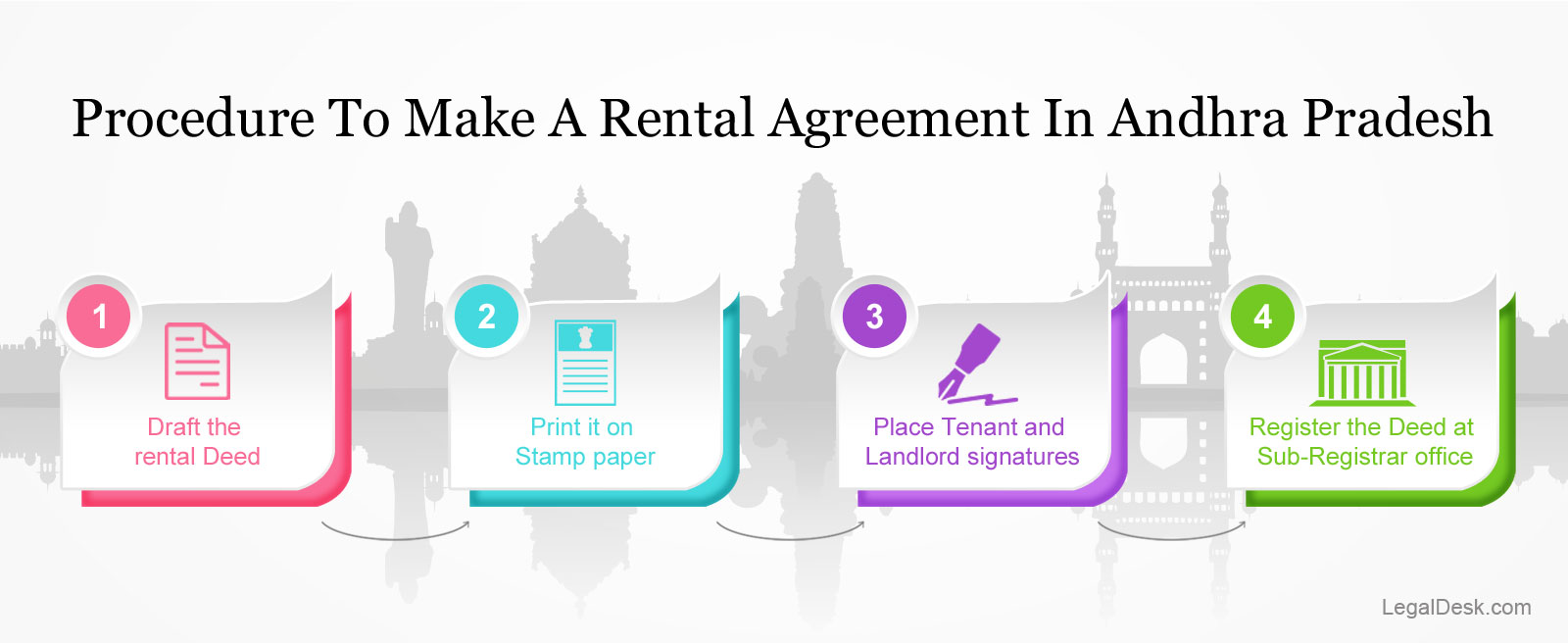
For a rent agreement in Andhra Pradesh to carry legal weight, it must be executed on appropriately valued stamp paper and, in certain cases, registered with the local Sub-Registrar’s office.
Is Rent Agreement Mandatory in Andhra Pradesh?
A rent agreement is not legally mandatory under Indian law, but it is strongly recommended for all landlord-tenant relationships. Without a written agreement, establishing the terms of tenancy — such as the rent amount, notice period, or deposit refund — becomes a matter of word against word.
Here is why a written rent agreement matters in practice:
- It is required for police verification of tenants, which many local authorities mandate.
- Banks and employers often ask for a rent agreement as proof of address.
- It is essential for resolving disputes through the Rent Controller or civil courts.
- Without one, landlords have limited legal recourse in case of default or property damage.
Andhra Pradesh Rent Control Act Explained
Rental relationships in Andhra Pradesh are primarily governed by general property laws, including the Transfer of Property Act, 1882 and the Registration Act, 1908. The state has its own Andhra Pradesh Buildings (Lease, Rent and Eviction) Control Act, which provides additional protections for both tenants and landlords.
Key provisions of this law include:
- Tenant protection: Landlords cannot evict a tenant without valid legal grounds such as non-payment of rent, subletting without consent, or misuse of the property.
- Rent fixation: In certain cases, tenants can approach the Rent Controller if they believe the rent being charged is excessive or has been revised without proper notice.
- Landlord rights: Landlords have the right to reclaim the property for personal use, subject to advance notice and compliance with procedural requirements.
- Dispute resolution: Both parties can approach the Rent Controller — a designated authority under the Act — for resolving disputes without going directly to civil courts.
Understanding these provisions before drafting a rent agreement in Andhra Pradesh ensures that neither party inadvertently violates statutory protections.
Stamp Duty on Rent Agreement in Andhra Pradesh
Stamp duty is a state-level tax levied on legal documents to make them valid and admissible in court. The stamp duty applicable to an Andhra Pradesh rent agreement is governed by the Indian Stamp Act, 1899, read with state-specific schedule amendments.
The stamp duty is calculated based on the lease duration and the annual rent amount. Here is a general overview:
| Lease Duration | Stamp Duty Applicability |
|---|---|
| 0 – 10 Years | 0.4% of total rent payable |
| 10 – 20 Years | 0.6% of total rent payable |
| 20 – 30 Years | 0.8% of total rent payable |
| Above 30 Years | 5% of total rent payable |
Rental Agreement Registration Charges in Andhra Pradesh
Registration of a rent agreement becomes legally mandatory when the lease period exceeds 11 months, as per Section 17 of the Registration Act, 1908. An unregistered agreement for a term exceeding 11 months is not admissible as evidence in court.
The registration process involves:
- Paying registration fees to the Sub-Registrar’s office
- Both landlord and tenant appearing in person (or through authorised representatives)
- Producing two witnesses with valid identity proof
- Paying stamp duty on the agreement value
Registration fees in Andhra Pradesh are generally calculated as a percentage of the total rent value for the lease term, subject to a minimum and maximum cap set by the state. Additional charges such as scanning fees and e-filing charges may also apply.
For a standard residential lease, the combined cost of stamp duty and registration is relatively modest — typically ranging from a few hundred to a few thousand rupees — making registration a cost-effective protection for both parties.
Andhra Pradesh Rent Agreement Stamp Paper Rules
Stamp paper is the medium through which stamp duty is paid at the time of drafting a rent agreement. In Andhra Pradesh, the rules around stamp paper are as follows:
- Minimum stamp paper value must match or exceed the stamp duty computed on the agreement.
- E-Stamp paper issued by authorised banks and stamp vendors (through the Stock Holding Corporation of India) is accepted and is increasingly preferred over traditional physical stamp paper due to security features.
- Physical stamp paper purchased from licensed stamp vendors remains valid but is more susceptible to fraud.
- Stamp paper should be purchased in the name of one of the executing parties — typically the landlord.
- An agreement written on insufficient stamp paper is deficient and can be impounded; parties may be required to pay the deficit duty along with a penalty.
Using e-stamp paper is recommended for its authenticity, as each certificate carries a unique identification number verifiable online.
How to Create an Andhra Pradesh Rent Agreement Online?
Creating a rent agreement in Andhra Pradesh no longer requires multiple visits to a lawyer’s office. Online platforms now allow you to generate a legally compliant agreement in minutes. Here is a step-by-step process:
Step 1: Enter Landlord Details Provide the landlord’s full legal name, address, and contact details as per official identity documents.
Step 2: Add Tenant Details Enter the tenant’s name, permanent address, and Aadhaar or PAN number.
Step 3: Define Property Details Specify the complete address of the rental property, including locality, district, and pin code.
Step 4: Set Rent and Duration Enter the monthly rent, security deposit amount, lease start date, and duration.
Step 5: Add Clauses Include standard clauses for maintenance, utility bills, lock-in period, notice period, and any special conditions.
Step 6: Generate and Review The platform generates a draft agreement. Review all terms carefully before proceeding.
Step 7: Print on Stamp Paper or E-Sign Download the agreement, print it on stamp paper of appropriate value, and have both parties sign it in the presence of two witnesses. Some platforms also offer legally valid e-signing options.
Documents Required for Andhra Pradesh Rent Agreement
Gathering the right documents before drafting the agreement avoids delays. The following are typically required:
- Aadhaar Card or other government-issued photo ID of landlord and tenant
- PAN Card of both parties (for high-value transactions)
- Property documents or proof of ownership (for landlord)
- Recent utility bill of the rental property (as address proof)
- Passport-size photographs of landlord and tenant
- Identity proof of two witnesses
For NRI landlords, a power of attorney in favour of a resident representative may be required to execute the agreement locally.
Common Mistakes to Avoid
- Incorrect Stamp Duty: Using stamp paper of a lower value than required makes the agreement legally deficient and liable to impounding.
- Not Registering Long-Term Agreements: Any lease exceeding 11 months must be registered. Skipping registration renders the agreement inadmissible as court evidence.
- Vague Termination Clauses: Failing to specify notice periods and lock-in periods clearly is a frequent source of landlord-tenant conflicts.
- Missing Maintenance Clauses: Not defining who bears the cost of minor and major repairs leads to disputes during and after the tenancy.
- No Inventory Record: For furnished or semi-furnished properties, failing to attach an inventory list can complicate deposit refunds.
Frequently Asked Questions
What is the stamp duty on rent agreement in Andhra Pradesh?
Stamp duty on rent agreements in Andhra Pradesh varies based on lease duration and rent value, governed by the Indian Stamp Act, 1899, and state-level amendments. Short-term agreements of up to 11 months attract a lower fixed stamp duty, while longer leases are subject to higher rates.
Is registration mandatory for rent agreement in Andhra Pradesh?
Yes, registration is mandatory if the lease period exceeds 11 months, as required under Section 17 of the Registration Act, 1908. An unregistered long-term agreement is not legally admissible as evidence in court.
Can I create an Andhra Pradesh rent agreement online?
Yes, rent agreements can be created online through platforms offering legally compliant formats. You can enter details, generate the agreement, and print it on appropriate stamp paper or e-sign it.
What is the minimum stamp paper required for a rent agreement in Andhra Pradesh?
The minimum stamp paper value must equal the stamp duty computed on the agreement. This depends on the lease term and rent amount. Using e-stamp paper issued by authorised vendors is recommended for security and authenticity.
What happens if a rent agreement is not on proper stamp paper?
An agreement executed on insufficient stamp paper is legally deficient. Authorities can impound the document, and the parties may be required to pay the deficit duty along with a penalty before the agreement can be used as evidence.
Can an NRI landlord execute a rent agreement in Andhra Pradesh?
Yes, an NRI landlord can execute a rent agreement either in person or through a duly authorised representative holding a registered Power of Attorney.
What is the notice period typically included in an Andhra Pradesh rent agreement?
A notice period of one to three months is standard in most rent agreements. The specific period should be clearly stated in the agreement to avoid disputes at the time of termination.
Is police verification required for tenants in Andhra Pradesh?
While police verification rules vary by district, it is increasingly required or strongly encouraged. A valid rent agreement is a key document needed to complete the police verification process.
Legal References
This article draws on the following legislations applicable to rent agreements in Andhra Pradesh:
- Transfer of Property Act, 1882 — Governs lease agreements and the rights and duties of landlords and tenants
- Registration Act, 1908 — Mandates registration of leases exceeding 11 months
- Indian Stamp Act, 1899 (with state amendments) — Governs stamp duty on rental agreements
- Andhra Pradesh Buildings (Lease, Rent and Eviction) Control Act — State-level law providing additional tenant and landlord protections