 Request Customized Document
 In this fast paced world, where mutual trust is dwindling, you must secure any property-related agreements by means of a legally binding contract in an acceptable format and a rental agreement is no exception.
Whether you’re a landlord owning a property or a tenant looking to rent a property, it’s important that you make use of a valid rent agreement format inclusive of all the important clauses that can serve the purpose of a reference document for all the parties involved. The rent agreement should be error-free to protect the interests of both the parties and the document should serve as a collaborative evidence in case of a dispute.
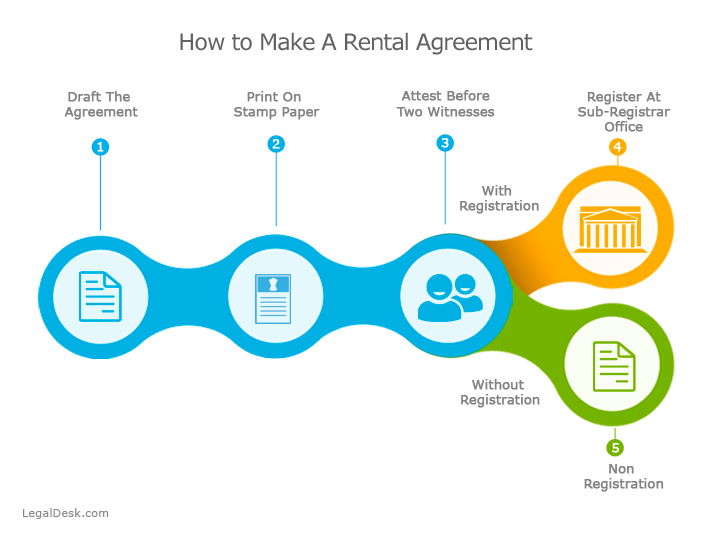 Use our easy to navigate interview questionnaire, fill in the required fields and you will have the most up to date rental agreement ready to print in minutes!!! At the end of this process, we will also tell you what you need to do to make this agreement legally valid.
You can create a rental agreement by using our easy and error-free rent agreement format in the following scenarios:
The important points to be covered in a rental agreement are as below:
Once you’re ready to print the document, follow the checklist below for an error-free agreement.
Yes. A rental (lease) agreement executed online is legally valid under the Indian Contract Act, 1872, provided both landlord and tenant are competent to contract, consent freely, and agree to lawful terms.
If the agreement is properly stamped as per the Indian Stamp Act, 1899 (and relevant State Stamp Act) and signed by both parties, it is enforceable in court. For leases of 12 months or more, registration is mandatory, otherwise, the document cannot be relied upon to prove tenancy terms (except for limited collateral purposes)
If the lease is less than 12 months → Only stamp duty payment is required. Registration is not mandatory.
If the lease is 12 months or more → Both stamp duty payment and registration are mandatory under Indian law.
Simple takeaway:
Yes. E-stamp certificates issued by authorized agencies are valid under the Indian Stamp Act, 1899 and corresponding State Stamp Acts. Courts treat e-stamp and physical stamp paper as equally valid for evidentiary purposes.
Yes. A properly stamped and signed rental agreement is generally accepted as valid proof of tenancy for HRA claims, bank KYC, employment verification, and other official purposes, subject to the specific policies and requirements of the employer, bank, or institution concerned
Digital signatures are recognized under the Information Technology Act, 2000. Digital Signatures are Legally valid, but practical enforceability depends on state registration procedures as certain Sub-Registrar offices and banks may still insist on physical signatures for registration or verification. Legaldesk provides options based on your state’s registration requirements.
Stamp duty is governed by the State Stamp Act applicable to the location of the property (e.g., Karnataka Stamp Act, Maharashtra Stamp Act).
The payable amount depends on:
Legaldesk automatically calculates the correct stamp duty based on your property location and agreement details.
If a rental agreement is not properly stamped, it may not be accepted as valid evidence in court (under the Indian Stamp Act, 1899.)
This means that if a dispute arises such as issues related to rent, eviction, or security deposit refund you may face difficulties enforcing your rights until the required stamp duty and penalties (if any) are paid
Yes. The landlord and tenant are free to include any mutually agreed terms in the rental agreement, as long as they are lawful and do not violate public policy. Common special clauses include:
These clauses help avoid misunderstandings and clearly define the rights and responsibilities of both parties.
If a tenant breaches the terms of the rental agreement, the landlord can take legal action (under the Indian Contract Act, 1872) and the applicable State Rent Control laws.
Depending on the nature of the breach and the terms of the agreement, the landlord may:
The exact remedy will depend on the violation and the conditions mentioned in the rental agreement
The refund of the security deposit is governed by the terms mentioned in the rental agreement.
If the landlord withholds the deposit without a valid reason under the agreement, the tenant can take legal action under the Indian Contract Act, 1872 and applicable civil laws to recover the amount. To avoid disputes, it is important to clearly mention refund timelines, permitted deductions, and handover conditions in the agreement.
Yes, a rental agreement can be terminated early if it contains a notice or early termination clause.The terms of termination including the notice period must be followed exactly as mentioned in the agreement. These rights arise from the contract itself (under the Indian Contract Act, 1872.)
If a party terminates the agreement without following the agreed terms, it may result in financial penalties or damages as specified in the agreement.
Notarisation is not mandatory under Indian law for rental agreements.
For agreements of less than 12 months, registration is not compulsory, and parties may choose to notarise the agreement for additional authentication. However, if the lease term is 12 months or more, registration is legally mandatory. In such cases, notarisation alone is not sufficient, for example, a notarised 3-year lease that is not registered will not be legally valid
Yes, provided the tenant holds a valid Power of Attorney from the landlord executed under the Powers of Attorney Act, 1882. The POA must authorise execution and registration of the lease.
Biometric verification may be required by the Sub-Registrar under local registration rules framed under the Registration Act, 1908. Legaldesk informs you in advance if biometric presence is mandatory in your city.
Once stamp duty is paid, the agreement becomes a legally valid document and cannot be casually changed. Minor clerical errors can be corrected with both parties’ signatures, but major changes (such as rent, duration, or names) generally require signing a fresh agreement or a separate correction document.
Only if such deductions are clearly mentioned in the agreement. Deductions not backed by contractual clauses may be challenged under general contract law principles.
No. A contract becomes binding only when both parties consent and sign, as required under the Indian Contract Act, 1872. Unsigned or one-sided agreements or agreements signed without free consent carry weak enforceability.
Yes. A properly stamped and signed, where required, registered rental agreement is admissible as evidence under Indian laws.
Legally, both fall under the concept of “lease” as defined in the Transfer of Property Act, 1882.
The term “rental agreement” is commonly used for short-term residential rents, while “lease deed” is used for longer or commercial arrangements.
Yes. Legaldesk provides assistance with:
Lawyer review of agreements, Drafting of legal notices, Guidance on dispute resolution procedures. This ensures you are not left alone after document execution.
A Lease, under the Transfer of Property Act, 1882 transfers an interest in the property to the tenant for a defined period. A Leave & License, under the Indian Easements Act, 1882 , creates only a permissive right to occupy without transfer of interest and is commonly used in certain states.
There is no uniform national cap. However, the Model Tenancy Act, 2021 recommends a maximum of two months’ rent for residential premises. The Model Tenancy Act is not automatically applicable unless adopted by the State.
The landlord should return the security deposit within the time mentioned in the rental agreement, after deducting any unpaid rent or genuine damage charges.
If no time is mentioned, it should be refunded within a reasonable time after the tenant vacates and hands over the property.
Unnecessary delay in returning the deposit can be treated as a breach of the agreement
Rent escalation during a fixed term is permitted only if the agreement expressly provides for it. Unilateral increase without contractual backing is not legally enforceable.
If the tenant pays rent late, the consequences depend on the rental agreement. The landlord may charge a late fee or interest if the agreement allows it.
If the tenant repeatedly delays or fails to pay rent, the landlord may issue a notice and, in serious cases, terminate the tenancy as per the terms of the agreement.
No. A landlord cannot evict a tenant whenever they wish. Eviction must follow the terms of the rental agreement and proper notice must be given.
The landlord cannot forcibly remove the tenant, change locks, or disconnect essential services. If the tenant does not vacate after notice, the landlord must follow the legal process for eviction
Yes, a tenant can leave before the lock-in period ends, but they may have to pay compensation as mentioned in the rental agreement. Such charges must be reasonable and reflect actual loss to the landlord. If the amount is excessive, a court may reduce it.
Unless the rental agreement states otherwise, the tenant is usually responsible for paying regular utility bills and day-to-day maintenance charges. The landlord is generally responsible for structural repairs and statutory dues related to the property.
Under Transfer of Property Act, 1882, generally, the landlord is responsible for major or structural repairs (like a leaking roof), while the tenant is responsible for day-to-day maintenance and any damage caused by misuse (like door handle damage).
Certain cities mandate tenant police verification under local police regulations.
Non-compliance may attract fines or other action depending on applicable local rules and enforcement practices.
Yes. Under Transfer of Property Act (Holding Over), continued acceptance of rent after lease expiry may create a month-to-month tenancy unless the landlord clearly objects or treats the occupant as an unauthorized tenant.
No. Under Indian Contract Act, 1872, Deposit forfeiture must correspond to actual loss and cannot operate as a penalty.
Yes. State Rent Control laws provide certain mandatory protections that can override terms mentioned in a rental agreement. However, if a property or tenancy is exempt from rent control laws such as some high-rent, commercial, or newly constructed properties the terms of the agreement will generally apply, subject to applicable laws.
Unlawful eviction occurs when a landlord tries to remove a tenant without following the legal process, for example, by changing locks, disconnecting electricity or water, or forcibly removing the tenant.
Yes. The Transfer of Property Act, 1882 mandates a monthly tenancy can be ended only after giving written notice. Generally, a 15-day notice is required for residential tenancies, unless a different notice period is agreed upon in the rental agreement.
Under Transfer of Property Act, 1882, if a rented property is sold, the new owner automatically becomes the landlord. The tenancy continues on the same terms and conditions as before. The new owner cannot evict the tenant before the tenancy period ends unless there are valid legal grounds under applicable rent or tenancy laws
Yes, disputes can generally be resolved through arbitration if the agreement between the parties includes an arbitration clause. However, certain matters such as eviction or tenancy disputes governed by rent control laws may still need to be decided by courts, even if an arbitration clause exists..
Under the IT Act 2000, notices served through Email or WhatsApp are considered valid modes of serving notices. However, the best practice is to serve both digital and physical notice.
In most cases, rent must still be paid even during unforeseen events.
Rent is usually payable unless the agreement specifically provides for rent suspension or the situation makes it legally impossible to use the premises.
If the contract does not mention rent relief, the tenant is generally expected to continue paying rent
Rights transfer to legal heirs. Tenancy continuity depends on contract terms and applicable state tenancy law. Consider it as rights over a property which get transferred to legal heirs.
No. Legal protections given to tenants under law cannot be taken away through a private agreement.
If a rental agreement includes a clause that removes or weakens mandatory legal rights of a tenant, such a clause is generally not enforceable
Oral tenancy is legally valid for monthly rent/leases but creates evidentiary challenges in disputes whereas written agreements reduce litigation risk and help clearly establish rent terms, duration, notice period, and responsibilities, preventing misuse or conflicting claims.
While we do have service all over India, the following states top our list of most popular places where our service is available quickly. Check out the list below-