
Creating a Will is one of the most vital financial and personal decisions you can make. When your estate involves multiple beneficiaries, such as a spouse, children, siblings, extended family, household staff, or charitable organizations, a clear, legally airtight document ensures your assets pass smoothly without triggering intra-family disputes or litigation.
Under the Indian Succession Act, 1925, drafting a legally enforceable Will does not require complex legal terminology, but it demands strict adherence to statutory rules and procedural execution.
Understanding Wills & Testamentary Rights in India
A Will (or testament) is a legal declaration made by an individual (the Testator) specifying how their assets should be managed and distributed after death.
Statutory Definition & Eligibility
According to Section 2(h) of the Indian Succession Act, 1925, any individual of sound mind who has attained majority (18 years under the Indian Majority Act, 1875) can execute a Will.
Self-Acquired vs. Ancestral Property
Before allocating assets, you must distinguish between the types of property you own:
- Self-Acquired Property: Assets purchased with your own income, acquired through personal investments, inherited through a Will, or received as an absolute gift. You have 100% testamentary freedom to distribute self-acquired assets to anyone you choose.
- Ancestral & Joint Family (HUF) Property: Property inherited up to four generations of male lineage without partition, or held under Hindu Undivided Family (HUF) coparcenary rights. You cannot bequeath ancestral property via a Will if other co-parceners hold a birthright claim. Any clause attempting to do so is legally void under Section 4 of the Hindu Succession Act, 1956.
Step-by-Step Guide: Distributing an Estate to Multiple Beneficiaries
Executing a multi-beneficiary Will requires structured planning to ensure clarity and balance across your estate.
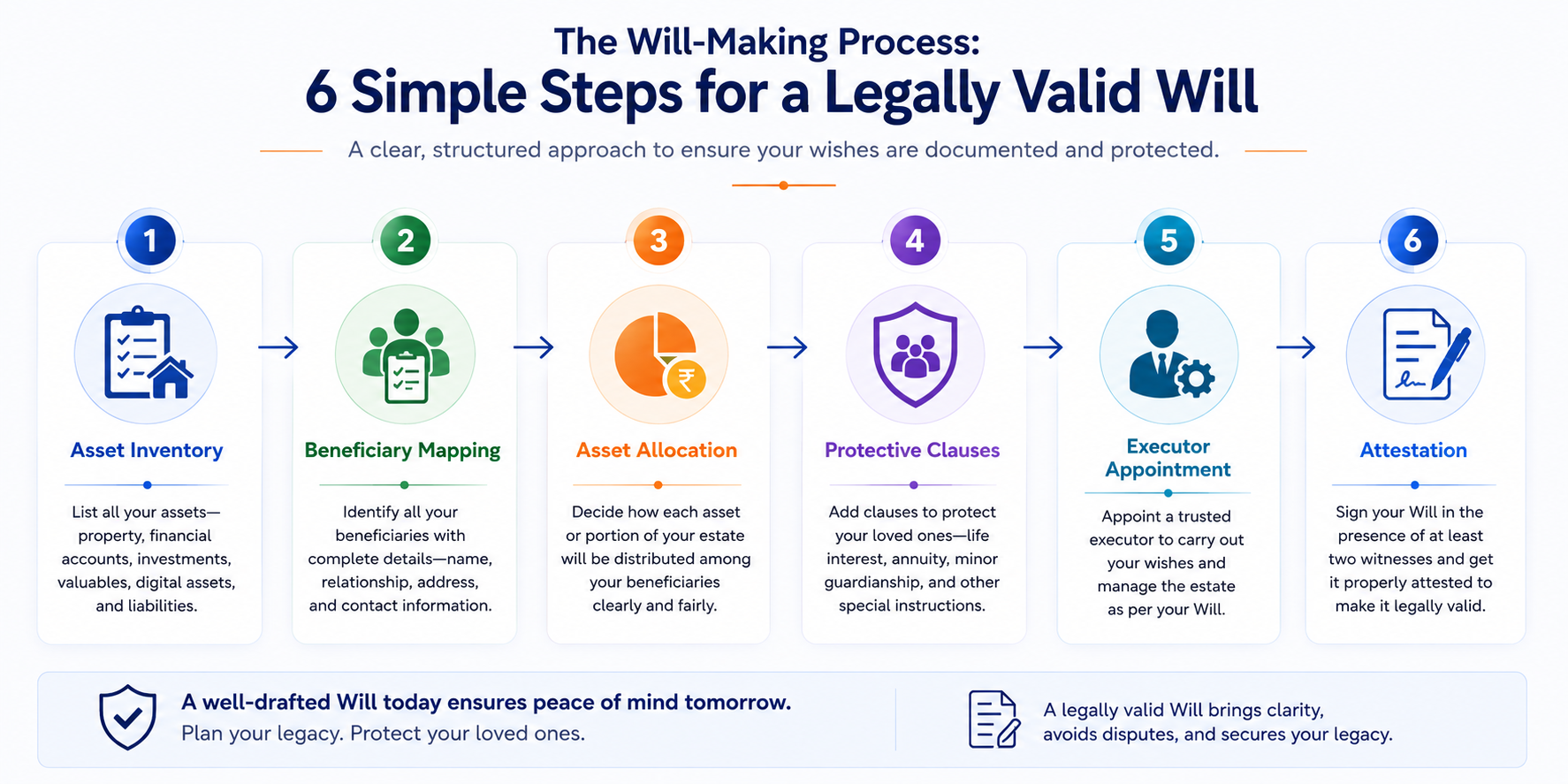
Step 1: Conduct a Comprehensive Asset Inventory
Compile an exhaustive list of all self-acquired assets:
- Immovable Assets: Real estate holdings, land, residential and commercial properties (include survey numbers, registration districts, and exact addresses).
- Financial Assets: Savings accounts, fixed deposits, demat accounts, mutual funds, government bonds, insurance policies, and Provident Fund (PF) balances.
- Movable Assets: Vehicles, jewelry, artwork, precious metals, and heirlooms.
- Digital Assets: Cryptocurrency wallets, domain names, online accounts, and monetized digital content. (Keep credential access instructions in a confidential sealed envelope held by your Executor).
Step 2: Detail Every Beneficiary Explicitly
To prevent identity confusion or challenges in court, record full identification markers for each beneficiary:
- Full legal name (as per Aadhaar, PAN, or passport)
- Date of birth and current age
- Permanent residential address
- Relationship to the Testator
- For Organizations/Charities: Registered legal name, registration number, and official address.
Step 3: Allocate Fractional Shares & Specific Bequests
When dividing single assets (such as a primary home or investment portfolio) among multiple beneficiaries, specify precise fractional shares or percentages rather than vague terms:
- Specific Bequest Example: “I give Plot No. 42, Sector 15, Gurugram, to my son [Name] absolutely.”
- Shared Asset Allocation: “I direct that my fixed deposit held with HDFC Bank (Account No. XXXX) be distributed in equal shares of 33.33% each to my three daughters.”
Critical Drafting Rule: Always include a Residuary Clause (e.g., “I give all the rest, residue, and remainder of my estate, both real and personal, to…”). This ensures that any unlisted, forgotten, or future assets pass to a designated heir rather than resulting in partial intestacy.
Step 4: Incorporate Protective Clauses
- Life Interest Clause: Grants a beneficiary (such as a surviving spouse) the right to occupy a residence or enjoy rental income for life without gaining ownership. Upon their passing, the asset transfers to a designated remainder beneficiary (e.g., children).
- Annuity Clause: Directs the Executor to make periodic disbursements from a dedicated fund to support a specific dependent (e.g., elderly parent or dependent relative).
- Guardianship for Minors: If any beneficiary is under 18 years of age, nominate a legal guardian to manage their inherited assets until they reach majority.
Step 5: Appoint an Executor
The Executor is legally responsible for carrying out the instructions in your Will, applying for Probate (if required), settling debts, and distributing the estate. Choose a trusted adult who is financially literate and preferably younger than you (or appoint an alternate Executor).
Step 6: Proper Execution & Attestation Rules
Under Section 63 of the Indian Succession Act, 1925:
- The Testator must sign or affix their thumb impression at the foot of every page and immediately below the last line of text.
- The document must be attested by at least two independent witnesses who observe the Testator signing the Will.
- The Witness-Beneficiary Rule (Section 67): A beneficiary or their spouse must not act as a witness. Doing so renders the specific bequest to that witness-beneficiary legally void, even though the overall Will remains valid.

What are the Legal Grounds on Which a Will Can Be Challenged in Court
Even a signed Will can be contested in a Civil Court. Understanding the recognized legal grounds under Indian law helps you draft a resilient document:
- Unsound Mind (Lack of Testamentary Capacity): Challenged under Section 59 of the Indian Succession Act, 1925. The contester must prove the Testator was suffering from a cognitive impairment, dementia, or insanity at the exact time of signing, rendering them incapable of understanding the nature and effect of their disposition.
- Mitigation: Attach a doctor’s certificate of mental fitness issued by a registered medical practitioner on the date of execution.
- Undue Influence, Coercion, or Duress: Challenged under Section 61. Occurs when a beneficiary uses dominant power, physical threat, or psychological manipulation to force the Testator to make a disposition against their true free will.
- Fraud or Forgery: Proving that the signature or thumb impression was forged, or that the Testator was tricked into signing a document they did not realize was a Will.
- Improper Execution or Lack of Attestation: Failure to comply with Section 63, such as having only one witness, witnesses not observing the Testator sign, or witnesses signing without the Testator’s presence.
- Suspicious Circumstances: Courts scrutinize Wills when unusual circumstances exist, such as an unexplained complete disinheritance of close family members, or when a major beneficiary played an active role in drafting the Will.
- Mitigation: Explicitly state objective, non-custodial reasons within the Will for excluding any natural legal heirs.
What are the Effects of Marriage and Remarriage on a Will
The legal impact of marriage on an existing Will varies significantly across religious and personal laws in India:
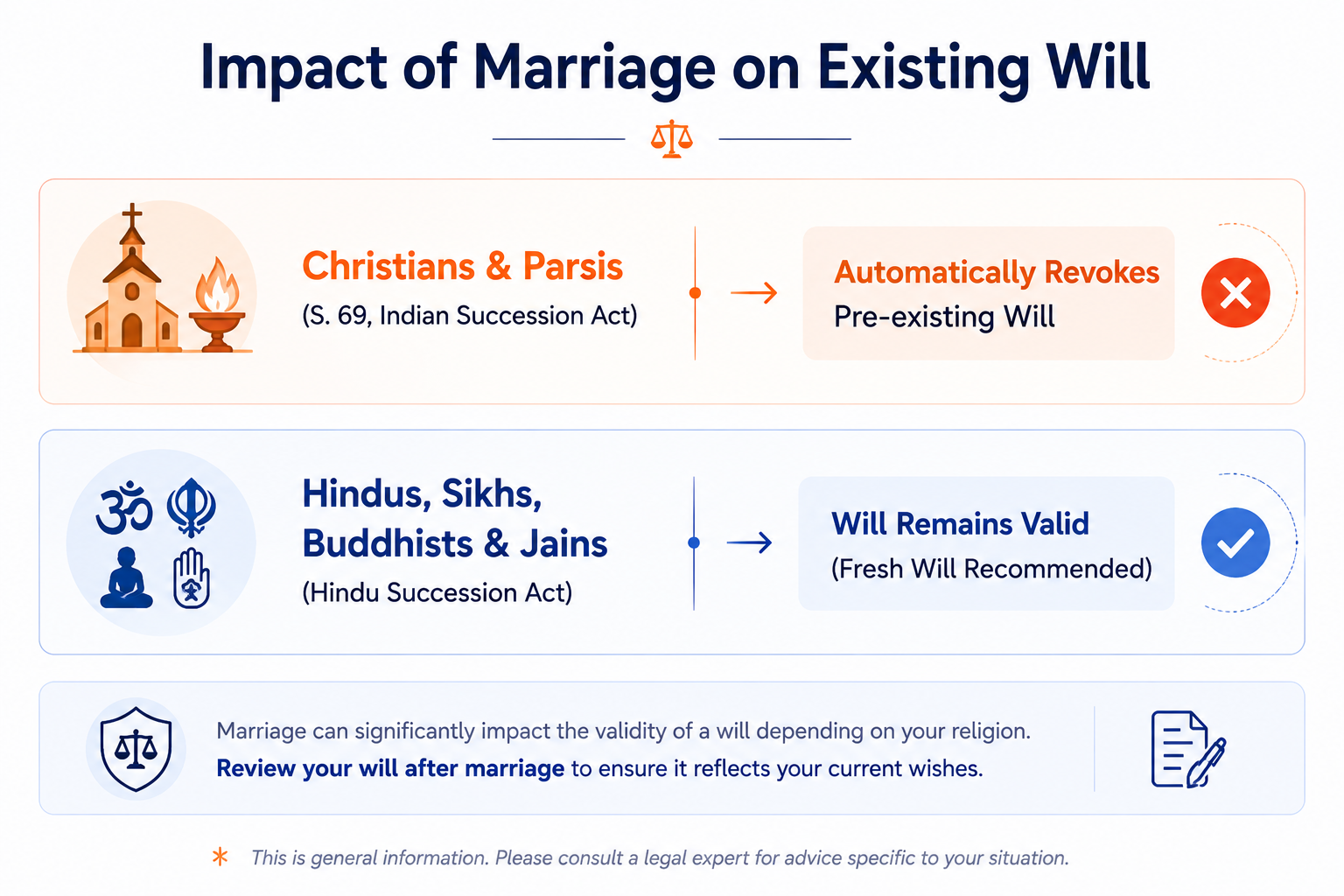
Christians and Parsis (Automatic Revocation)
Under Section 69 of the Indian Succession Act, 1925, every Will made by a Christian or Parsi is automatically revoked by their marriage.
- Legal Result: If you execute a Will as a single person and subsequently marry without executing a new Will, your earlier Will becomes legally void. Should you pass away, your estate will be distributed under intestate succession rules.
- Exception: A Will made in exercise of a power of appointment (where the property would not pass to your legal heirs if unexercised) is not revoked by marriage.
Hindus, Sikhs, Buddhists, and Jains
The rule of automatic revocation under Section 69 does not apply to Hindus, Sikhs, Buddhists, and Jains (pursuant to Section 57 read with Schedule III of the Indian Succession Act, 1925).
- Legal Result: Marriage does not automatically invalidate a pre-existing Will.
- Risk Factor: If you drafted a Will before marriage leaving all self-acquired property to your parents or siblings, that Will remains valid after marriage unless explicitly revoked. This could inadvertently leave your surviving spouse and children without a claim to your self-acquired estate.
- Best Practice: Always revoke your pre-marriage Will and execute a fresh Will upon marriage or remarriage to reflect your updated family structure.
Understanding Intestate Succession: Dying Without a Will
If an individual dies intestate (without a valid Will), personal laws dictate how self-acquired assets are divided:
- Hindus, Sikhs, Buddhists & Jains: Governed by the Hindu Succession Act, 1956. Class I legal heirs (spouse, children, mother) inherit equal shares first. Class II heirs inherit only if no Class I heirs survive.
- Christians & Parsis: Governed by the Indian Succession Act, 1925, dividing fixed statutory fractions between the surviving spouse and lineal descendants.
- Muslims: Governed by Muslim Personal Law (Shariat), where testamentary disposition (Wasiyat) is restricted to a maximum of one-third of the net estate for non-legal heirs.
- Escheat: If no legal heirs exist across any degree, the entire estate reverts to the State.
Secure Your Legacy Today
Drafting a Will protects your family from unnecessary administrative delays, high litigation expenses, and potential property disputes.
Take the Next Step:
- Gather your property titles, financial statements, and beneficiary details.
- Draft your allocations clearly, keeping fractional shares precise.
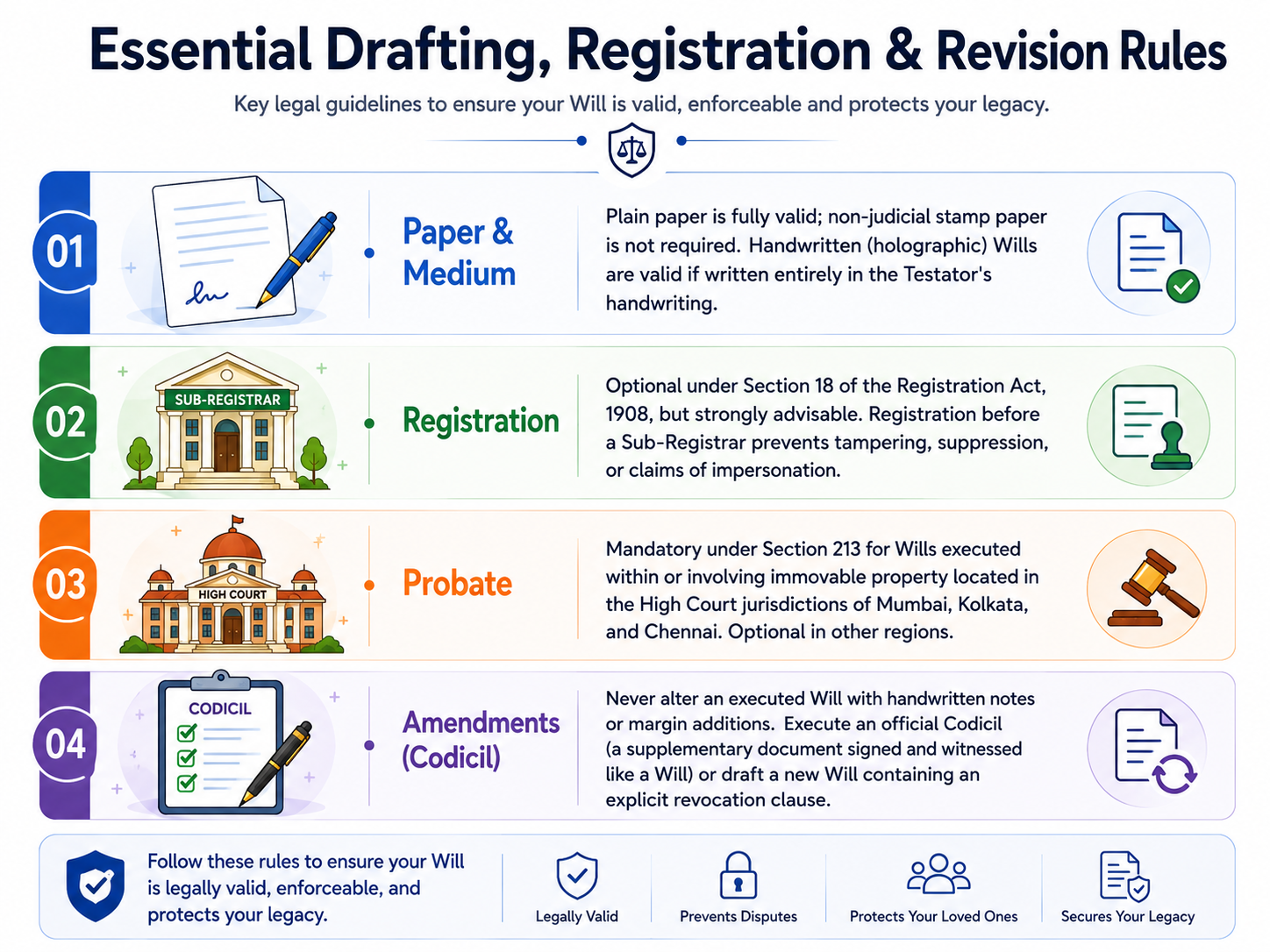
- Consult an experienced Indian estate planning advocate to review your draft, execute it in compliance with Section 63, and register it at your local Sub-Registrar’s office.
Legal Disclaimer: This guide provides general information about Wills under Indian law. It does not constitute legal advice. Consult a qualified advocate for advice specific to your circumstances.
Frequently Asked Questions (FAQs)
-
-
Can I completely disinherit my spouse or children from my self-acquired property?
Yes. You have absolute discretion over self-acquired assets. However, to prevent successful legal challenges based on “suspicious circumstances,” you should explicitly detail the reasons for their exclusion within the document.
-
Does a registered Will completely prevent legal challenges?
No. Registration provides strong evidence of authenticity and capacity, but a registered Will can still be challenged in court on grounds such as forgery, undue influence, or lack of testamentary capacity.
-
What is the simplest way to revoke an old Will?
The most reliable method is to draft a new Will that includes an express clause: “I hereby revoke all former Wills and testamentary dispositions previously made by me.” You should also physically destroy older copies.
-
Is Probate mandatory in India, and which states require it?
Probate, a court certification of a Will’s authenticity, is mandatory under Section 213 of the Indian Succession Act, 1925, in the original civil court jurisdictions of Mumbai, Kolkata, and Chennai for Wills of immovable property. It is optional elsewhere, though a Grant of Probate provides conclusive legal finality, simplifies asset transfers, and protects the Executor from personal liability.
-